Cat urine on paper presents a problem that conventional textile-cleaning methods cannot solve. Saturating a page with enzymatic cleaner or white vinegar causes warping, watermarks, and mold. To get cat pee smell out of a book, you need to think in terms of paper conservation, not household cleaning.
Drying a book soiled with cat urine: the critical first step
A book that is still damp with urine cannot be deodorized. Trying to absorb odors from wet pages only makes things worse: the paper swells, the fibers become distorted, and conditions become favorable for mold growth.
The absolute priority is controlled drying before any treatment. Place sheets of unprinted absorbent paper (such as white paper towels or blotting paper) between the affected pages. Change them every hour while they continue to absorb moisture. More tips are available on this page about getting cat pee smell out of a book.
Stand the book upright, slightly fanned open, in a well-ventilated place away from direct sunlight. Avoid dry heat (radiators, hair dryers): it sets odor-causing compounds into the fibers and weakens the binding glue.
Coated paper: a special case
Glossy pages in coffee-table books or catalogs pose an additional risk. Coated paper sticks together permanently if it dries with the pages touching. Be sure to separate each damp sheet with an interleaf before the drying process gets underway.
If immediate drying is not possible (several books are affected or you will be away for an extended period), freezing the book in an airtight bag is a temporary measure. It stops fungal growth and stabilizes the paper, but does not replace drying or subsequent deodorizing.
Baking soda and activated charcoal: absorbing odors from dry paper
Once the book is completely dry, two absorbents stand out for their effectiveness on paper without the risk of chemical damage.
Baking soda in a sealed container
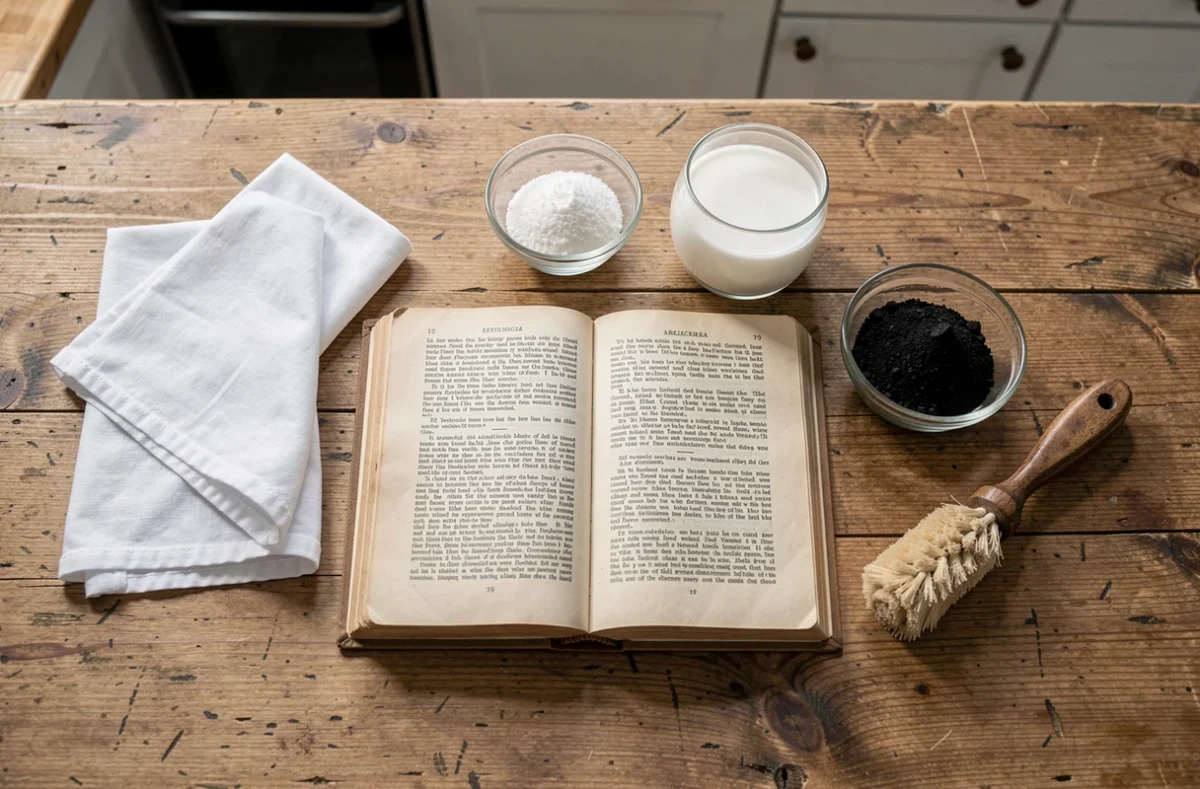
Do not apply baking soda directly to the pages. The reliable method is to seal the book in an airtight container (a plastic box or a large zip-top bag) with a small dish of baking soda.
- Pour a generous layer of baking soda into an open container and place it beside the book, without letting it touch the pages
- Seal the container and leave it for at least 48 hours, ideally a week if the urine has soaked in for a long time
- Replace the baking soda halfway through if the cat urine smell is still there when you open the container
Baking soda absorbs the volatile molecules responsible for the odor, including ammonia and thiols. This passive approach preserves the paper because no liquid is involved.
Activated charcoal: an alternative for stubborn odors
Activated charcoal granules or sachets work on the same adsorption principle, with a greater capacity to capture sulfur compounds. We recommend using it when the urine has been dry for a long time and the odor has become deeply embedded.
The process is the same: a sealed container, no direct contact, and an extended treatment time. Activated charcoal is available at pet stores (aquarium filters) or hardware stores.
Spot-treating pages stained with cat pee
The odor sometimes lingers on pages that were directly affected, even after treatment in a sealed container. Spot cleaning may then be an option, provided you carefully control the amount of liquid used.
Blot the stained area with a cotton ball barely dampened with diluted white vinegar (one part vinegar to three parts water). Use a light dabbing motion, not a rubbing motion. Acetic acid partially neutralizes uric acid salts, the main cause of lingering cat urine odor.
Immediately place a sheet of blotting paper under the treated page and another on top. Leave it to dry flat under a light weight (such as another book) to minimize warping.
- Never go beyond the stained area: water can leave marks on clean paper
- Avoid this method on old inks, inkjet-printed illustrations, or manuscripts: diluted vinegar can cause some pigments to run
- Test first on an inconspicuous corner of the affected page
- Do not combine vinegar and baking soda directly on the paper: the reaction produces CO2 and water, unnecessarily saturating the fibers
Enzymatic cleaners and books: why caution is essential
Enzymatic cleaners are the go-to solution for treating cat urine on textiles and floors. They work using enzymes (proteases and ureases) that break down uric acid crystals at the source. The problem is that these products need to saturate the material to work deep down.
That level of saturation is acceptable on a rug or mattress. On paper, it can cause damage that is often irreversible: pages sticking together, a warped binding, and mold growth in the following days if the book does not dry completely.
An enzymatic cleaner may be suitable for the cardboard cover or the edges of a hardback book, applied sparingly with a cotton ball. On the pages themselves, the risks outweigh the benefits.
When to take the book to a conservator
Some books warrant professional treatment: rare editions, antique books, signed copies, or books with significant sentimental value. A paper conservator has access to nebulization techniques and deodorizing chambers that treat odors without wetting the paper.
A borrowed or library book also deserves this attention if passive methods have not worked. The cost of restoration is still lower than replacing an out-of-print book.
Treatment with baking soda or activated charcoal in a sealed container resolves most cases of cat urine odor in books. The key is patience: allow one to two weeks for a complete result if the urine has soaked in for a long time, replacing the absorbent regularly.