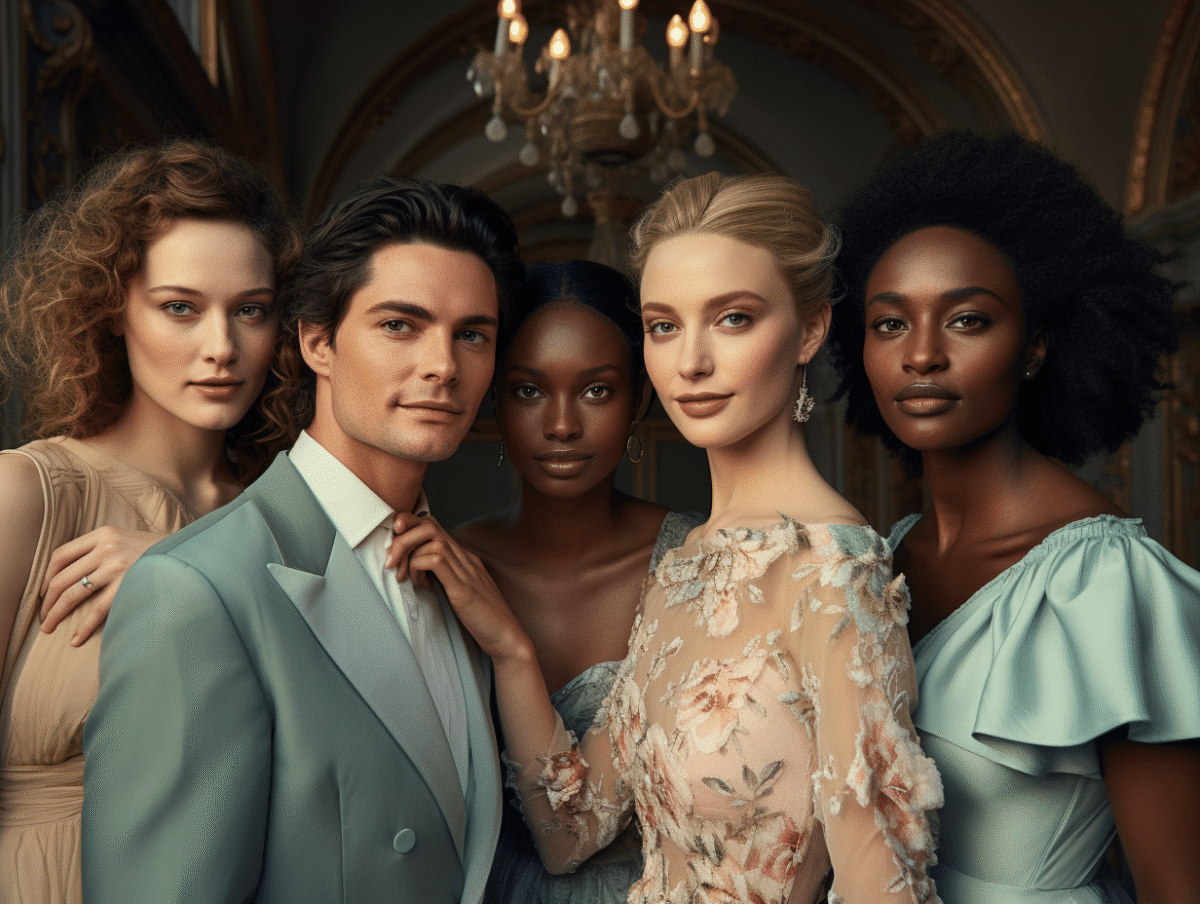
The fashion and film industry has been shaped by iconic figures whose charisma and aesthetics have transcended eras. These icons, often professional models, have not only defined beauty standards but have also influenced popular culture and trends. Names like Twiggy, with her typical 60s androgynous silhouette, to Cindy Crawford and her iconic beauty mark, and the versatility of Brooke Shields, who successfully navigated between the two worlds, have left an indelible mark on the visual landscape of their time.
Cross-Over Icons of Fashion and Film
In the sparkling world of fashion and film, a few figures stand out for their ability to navigate effortlessly between the two realms. Jari Jones, plus-size model, actress, director, and trans activist, embodies this duality. A muse for Calvin Klein, she has highlighted diversity and inclusivity in the fashion industry while producing the film ‘Port Authority’, which explores the complexities of gender identities. Her bold presence and commitment make her a powerful symbol of the convergence between fashion and film.
Paloma Jiménez, although less known for her film roles, is an emblematic figure of this ability to transcend the boundaries of the industry. Her stature, grace, and work in front of the camera have elevated her to the status of muse for prestigious brands, while her personal life places her under the spotlight of another stage: that of the public and cinematic sphere, where her image becomes a vehicle for storytelling.
The rise of Jari Jones is also significant of the evolution of the influence of models in popular culture. On the cover of publications such as ‘Teen Vogue’ and ‘British Vogue’, she has used her fame to speak out on social and cultural issues, notably through op-eds in ‘The New York Times’, ‘Nylon’, and ‘Out Magazine’. Influential beyond the runways, she shapes public opinion by addressing queer, transgender, and racial issues, proving that today’s models are much more than faces; they are voices that matter.

The Evolution of Model Influence in Popular Culture
Jari Jones, a key figure in this transformation, does not just walk the runway or pose. Her presence on the cover of ‘Teen Vogue’ and ‘British Vogue’ marks an era where models infuse culture with their activism and personal vision. Author of op-eds in leading publications like ‘The New York Times’, ‘Nylon’, or ‘Out Magazine’, Jones addresses queer, transgender, and racial themes head-on, extending her influence well beyond traditional fashion clichés.
In the wake of Jones, Ashley Graham has risen among the most influential models of her generation. Cited by ‘Models.com’, her presence is a constant in the pages of ‘Sports Illustrated’, ‘Grazia UK’, ‘Maxim’, ‘Vogue US’, ‘Harper’s Bazaar’, ‘Glamour’, ‘Marie Claire Italia’, and others. Her participation in runway shows for brands such as Prabal Gurung, Dolce & Gabbana, Christian Siriano, or Michael Kors reflects the breaking of fashion stereotypes. Graham perfectly illustrates how plus-size models are conquering new spaces of expression and representation.
Tess Holliday, body-positive activist and plus-size model, has also contributed to redefining beauty standards in the industry. Her collaborations with brands like Benefit and H&M, her appearances in ‘Vogue Italia’, ‘Marie Claire UK’, and ‘Self Magazine’, as well as her presence on the runways of Chromat, have solidified her status as an icon. Holliday is also the founder of the #EffYourBeautyStandards movement, which encourages broader acceptance of diverse body types, thus influencing the perception of beauty on a global scale.
Today’s models are agents of change, protagonists of cultural storytelling. Their actions, their voices, and their commitments shape mindsets and sculpt the future of the fashion industry and beyond. Social media amplifies their voices, allowing for direct interaction with the public and a tangible influence on society. Fashion no longer just displays silhouettes; it highlights personalities, struggles, and stories that resonate with an audience seeking meaning and authenticity.